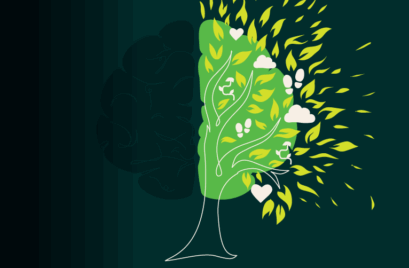
Most of us, either directly or indirectly, have experienced the disruption of a natural disaster. Increasing in frequency and intensity, these events create enormous upheaval as well as fear and anxiety about the future. If, however, we take the time to observe nature in its recovery, we can learn valuable lessons of successful adaptation and thriving beyond disruption. After a summer wildfire scorches the earth or a thunderstorm uproots trees and devastates wildlife, the landscape doesn’t return to its former state; it regenerates.
This process of regeneration results in ecosystems that are more resilient to future disruptions. For example, a forest recovering from a fire may develop a mix of fire-resistant species or those better equipped to withstand future heat stress, ultimately strengthening the ecosystem in the long term. Regeneration can also lead to greater biodiversity, as new species occupy ecological niches left vacant by those lost. Species may adapt to changing environmental conditions, fostering a more diverse and complex ecosystem. This process of regeneration goes beyond recovery towards transformation: an adaptive and sustainable response to adversity.
The landscape of leadership today is increasingly defined by disruption, and like the natural environment these disruptions are becoming more intense and more frequent. From AI-driven acceleration to cybersecurity risks, skills shortages and global political instability to the rising expectations of stakeholders. Traditional leadership approaches, which rely on predictability, stability and control are no longer sufficient. Our established systems and processes are too slow and rigid in this new and rapidly shifting terrain.
As author Ben Rennie urges:
“It’s time to toss out the old map and switch to real-time navigation.”
Real-time navigation is about being deeply present in the moment, attuning to the emerging needs of both self and system, and responding regeneratively. In nature, ecosystems don’t repeat ‘tried and true’ pathways, they adapt in real-time to changing conditions, responding to disruptions in ways that renew and sustain life. Similarly, we can no longer follow a fixed route, we must cultivate the ability to navigate dynamically, making decisions based on real-time insights for regenerative futures. Regenerative leadership acknowledges that while disruption may feel chaotic and overwhelming in the moment, it ultimately leads to a system better suited to its environment.
So, what are the tools of real-time navigation? What does this new approach to leadership look like? Among the plethora of potential responses, three concepts emerge as central to regeneration: connection, creativity, and courage. These concepts, manifest in action, can be developed through conscious practice and reflection.
Experiments in Regenerative Leadership
Connection
“Connection is why we’re here; it is what gives purpose and meaning to our lives.”
Brené Brown
Connection is at the heart of regenerative leadership. It’s the practice of nurturing the relationships, systems, and environments that allow life and leadership to flourish. Connection begins with attunement: to self, to others, and to the wider ecosystem in which we operate. It calls for empathy, reciprocity, and the capacity to listen deeply, creating spaces where people are seen, valued, and empowered to contribute. To experiment in cultivating connection, try:
Presencing: Choose a scheduled meeting that is challenging for you or doesn’t always go as you envisage. Try deep listening. Resist the urge to state your position, or immediately problem-solve. Attempt to discover how others are thinking and feeling, get curious and aim to discover something you didn’t know or understand previously.
Mapping Interconnections: On a whiteboard, map out key relationships, processes, and systems in your organisation. Identify gaps or points of stress, then experiment with interventions to strengthen those links.
Cross-Team Collaboration Experiments: Pair people from different functions for short-term projects to encourage knowledge sharing and diverse perspective taking. Observe how relationships and ideas evolve.
Creativity
“Everyone has huge creative capacities. The challenge is to develop them.”
Sir Ken Robinson
Creativity is an exploratory process, a way of seeing, questioning, and imagining that invites us to let go of old assumptions and habitual patterns of thought. It involves experimenting with new perspectives, embracing uncertainty, and generating ideas that are both novel and meaningful. Mihaly Csikszentmihalyi, pioneer of the psychology of ‘optimal experience’, describes creativity as the ability to approach challenges with fresh, adaptive strategies while continuously responding to an ever-changing moment. At its core, creativity is about curiosity and intuition, backing yourself and your people to discover paths that were previously invisible. To experiment in cultivating creativity, try:
Idea Sprints: Allocate short periods for teams to brainstorm multiple solutions to a single challenge, initially emphasising quantity over quality. Make these open, playful sprints where no idea is a bad idea, and thoughts can build freely on one another. Frame the session with divergent thinking techniques to prompt the team’s creativity.
Perspective Shifts: Encourage team members to imagine solutions from different stakeholder viewpoints, opposing positions, and/or future generations. Draw parallels from unrelated fields through analogy or consider how someone you admire might approach this challenge, for example: What would Steven Spielberg do in this situation?
Engage with Art: Art activates and integrates brain regions that don’t usually work together in everyday, goal-directed tasks, generating new pathways for divergent thinking. Try partnering with a local gallery, artist, or creative organisation to design a team encounter. Invite a First Nations storyteller to share their relationship with listening and story. Do theatre sports, or an open mic night at your local comedy club.
Courage
“Courage is being scared to death … and saddling up anyway.”
John Wayne
Regenerative leadership calls for the courage to step into the unknown. Taking that step means recognising that something more important than fear is at stake, it’s a gesture rooted in integrity, trust, and hope. Courage is choosing to act despite uncertainty, it’s the resolve to uphold your principles when the path ahead is unclear, to make difficult decisions with honesty, and to face discomfort in service of something larger than yourself. In an environment of perpetual change, courage means leading without a fixed map, but with conviction, humility, and a steady moral compass to guide the way. To experiment in cultivating courage, try:
Decision Reflection Practices: After a challenging decision, reflect on the core intention behind the decision, how it aligned with the values, and purpose of your organisation. Consider who was affected and how, and did you act in ways that preserved dignity and fairness. How did you show up as a leader and what did you learn about yourself?
Transparent Communication: Model courage by openly discussing unknowns, uncertainties, and potential risks with your team. By acknowledging what is unclear or may fail, leaders normalise ambiguity, reduce fear, and create space for collective problem-solving and innovation.
Explore Ethical Dilemmas: Engage an external facilitator who brings expertise in scenario design, safe exploration of moral tension, and structured debriefing. They can Facilitate sessions where leaders and teams explore difficult choices, weighing values and trade-offs, building moral courage in decision-making.
As a form of integration across all three concepts: connection, creativity and courage develop a practice of Leadership Journaling. Set a regular rhythm for your journal writing, make initial observations, notice patterns, capture insights, and explore how you show up as a leader. As a starting point you could answer these questions:
- How did I connect with others today and what did I notice?
- What assumptions or habitual patterns did I experience today, was I aware of them and did I attempt to shift them?
- How did I step towards courage or avoid it?
By viewing disruption as a chance to regenerate, leaders can create environments that foster adaptability, inclusivity, and renewal, enabling their organisations to not only survive but thrive, emerging stronger, wiser, and more connected. Regenerative leadership, like natural ecosystems, transforms adversity into opportunity, helping both leaders and organisations evolve to shape dynamic and sustainable futures.
References:
Brown, B. (2012) Daring greatly: How the courage to be vulnerable transforms the way we live, love, parent, and lead. New York: Gotham Books.
Csikszentmihalyi, M. (1996) Creativity: Flow and the psychology of discovery and invention. New York: Harper Perennial.
Robinson, K. (2001) Out of our minds: Learning to be creative. London: Capstone.
Schechner, R. (2013) Performance studies: An introduction. 3rd edn. London: Routledge.