In the age of instant answers, do we ever stop to think what we have lost?
I recently had a proposal to write: tight turnaround, real stakes, and I was already drowning in deadlines. I thought, what’s the harm in skipping that time-consuming, brain-draining process of sitting with an idea just this once? I headed straight to AI, got something polished and fast, and for a moment, it felt productive.
But when I looked at it, beyond a cursory glance, I realised I’d skipped the work. I’d taken the first idea handed to me and closed the thought loop too early. It was concise, but it wasn’t alive. It didn’t sound like me or carry any of the depth and originality I’m known for. I had to scrap it and start again – now, with even less time.
I know I’m not alone in this story. It’s arguably one of the most important tensions facing leaders right now: the faster we move, the more deliberate we must become about how we think.
Efficiency cannot come at the cost of human curiosity.
Speed has a shadow
AI can search, summarise and generate at extraordinary speed. It makes us feel more informed, certain, and productive. But it cannot replicate the often slow, and much less glamorous work of genuine curious inquiry – the process of staying with a problem long enough for deep, original thought to emerge.
Speed feels like progress, particularly in environments that reward action, decisiveness, and responsiveness. Deloitte’s 2026 Global Human Capital Trends report found that 7 in 10 business leaders now see being “fast and nimble” as their primary competitive strategy over the next three years. That raises a question: if speed is the strategy, what protects originality and wisdom?
Our brains compound the issue. Daniel Kahneman’s research on fast and slow thinking shows us that our brains are wired to default to the quick, effortless answer. System 1 thinking is fast, automatic, and energy-efficient. System 2 — the slower, more deliberate mode where real inquiry lives — requires effort the brain would rather not spend.
So when both the business and the brain reward quick resolution, the loop closes fast. People stop pausing, challenging, or exploring new horizons. When people stop questioning, they stop learning. And when learning slows, organisations become brittle.
We’re letting convenience harm the capability we need most.
Curiosity is a leadership discipline
Creative thinking rarely begins with the first idea. It happens when we keep pushing past the obvious, and follow hidden pathways to unexpected places. Curiosity calls us to open the door — and it is that capacity, more than any tool or technology, that keeps organisations learning, adapting, and alive.
Curiosity is not the opposite of speed. It is what prevents speed from eroding depth.
AI can give us information quickly. Curiosity helps us make sense of it. AI can suggest a response. Curiosity helps us notice what is missing. AI can close the loop. Curiosity keeps it open just long enough for depth to appear.
This capacity to stay open long enough for something nuanced and original to emerge is what keeps people learning-oriented in complexity. It helps teams remain inventive when the future is unclear, and is what allows organisations to move from rigidity to agility. It is an innately human capacity – ours to protect and strengthen, if we decide to.
Practising curiosity
One pathway starts in the body.
Dr Bruce Perry’s framework of Regulate, Relate, Reason describes the sequence needed for higher-order thinking to emerge. Before we can think well, we need to be settled enough to think at all. Before we can explore, we need to feel connected enough to stay open. Only then can reasoning do its best work.
If people are tense, defensive, rushed, or overwhelmed, they will not stay curious for long. Curiosity starts in the breath, a pause, a moment of deliberate attention. These small moments of regulation create the internal space for reflection instead of reaction. They let us hear the question beneath the noise.
Curiosity is also relational. People are more willing to challenge, explore, and think aloud when they feel safe enough to do so. Leaders don’t just ask for curiosity, they model it through the quality of their listening, the tone of their responses, and the way they react when someone offers a half-formed idea or a difficult truth.
And then comes reason. Once people are regulated and connected, they can use their executive functions more effectively. At this stage, we can begin to develop the art of questioning. The real work is not merely asking more questions; it is asking more effective ones, at the right time, in the right context, and with enough patience to let the answer emerge.
Our ASK Toolkit offers one tangible framework for exactly this — putting questions physically into people’s hands, slowing the pace, and making intentional inquiry a habit.
Curiosity is a vital human capacity and competitive advantage
AI will continue to get faster, more fluent, and more helpful. That is not the real issue. The real issue is whether we will preserve the human capacities that give speed its value in the first place: judgment, imagination, discernment, courage, and the ability to stay with uncertainty long enough to learn from it.
The organisations that thrive will not be the ones that move fastest at all costs, hurtling blindly in a direction chosen by something with no stakes in where they land. Organisations that thrive will be the ones that slow down enough to think well, challenge well, and learn well. They will use AI to accelerate work, and not to shortcut wisdom. They will understand that the most valuable capability in a machine-rich world is not efficiency alone, but the human capacity to remain curious.
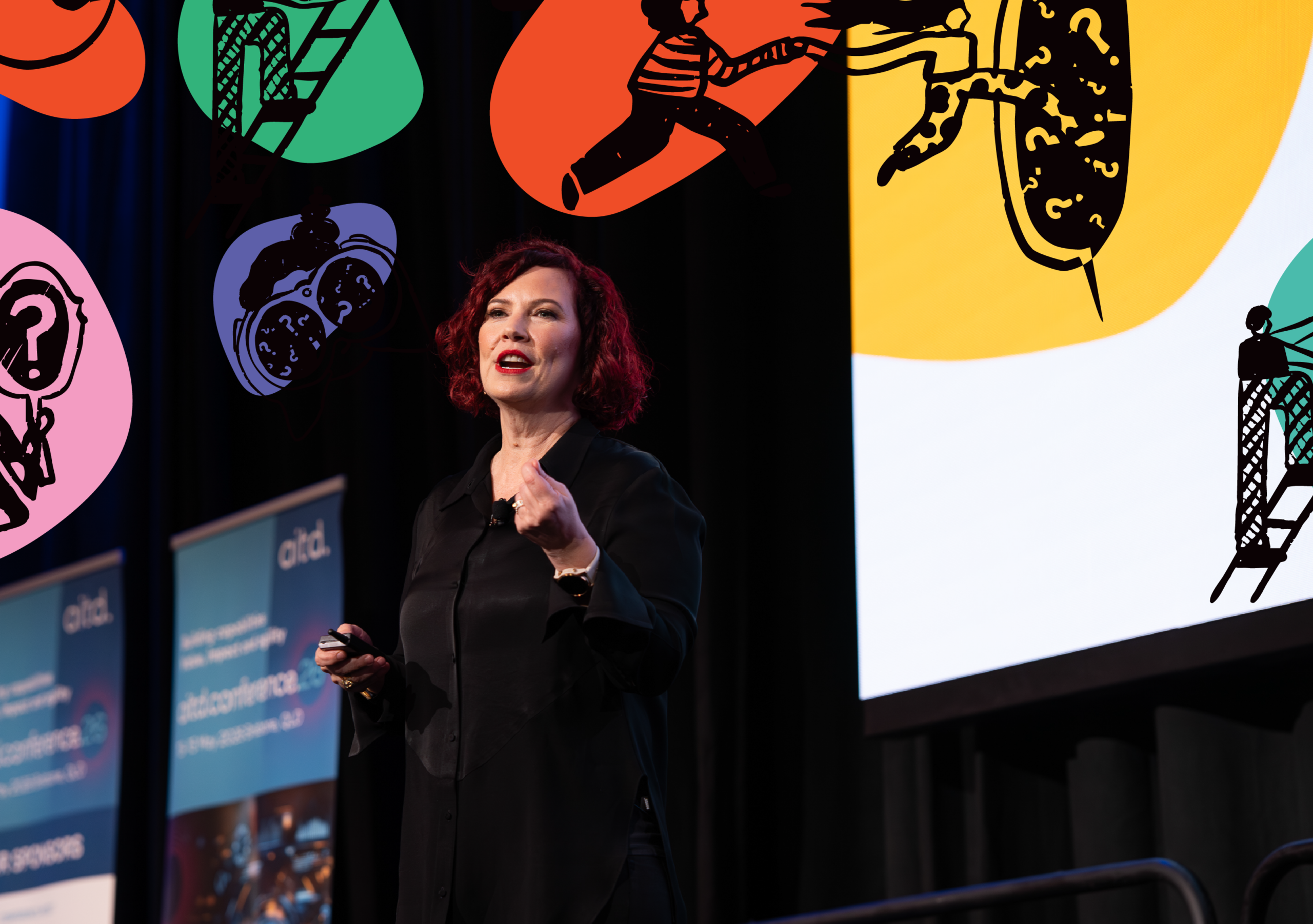
This article was adapted from the keynote delivered at AITD National Conference in May 2026. Interested in booking an interactive keynote experience tailored to your team?
Contact us.
References:
1 Perry, B. (2024) https://www.youtube.com/watch?si=YJ6YFPQkWCUMdR7Z&v=lw0yUOdzSpg&feature=youtu.be
2 Kahnemann, D. (2011), Thinking Fast and Slow
3 https://www.deloitte.com/au/en/services/consulting/research/global-human-capital-trends.html
4 https://www.frontiersin.org/journals/behavioral-neuroscience/articles/10.3389/fnbeh.2021.634158/full
5 Anne Mangen; Kari Spjeldnæs (2025) Engaging with Literature in Print, on Screen Displays, and in Audiobooks : Current Findings and Perspectives for Future Empirical Research. I: Jan Alber; Ralf Schneider, The Routledge Companion to Literature and Cognitive Studies. Routledge. ISBN 9781032470504. s.494-505. DOI: 10.4324/9781003387473-44